In modern food production, safe and hygienic packaging is a non-negotiable regulatory requirement. However, for long-term profitability, you must also focus on achieving the highest level of overall equipment effectiveness (OEE).
This journey begins with a clear understanding of your product’s physical properties, which ultimately dictates whether a horizontal or vertical cartoner is the right choice.
Let’s explore a strategic framework that will help you select an effective secondary packaging solution.
Understanding Cartoning Machines
Horizontal cartoners and vertical cartoners are two dominant technologies that differ fundamentally in carton orientation and product loading mechanics.
In food packaging, you must choose a machine that aligns with your product’s physical properties, upstream process stability, and long-term scale.
Vertical Cartoners
Vertical cartoners typically erect cartons and hold them in upright positions as product is loaded from the top using gravity. These cartoners perform best in variable production volumes, multiple product SKUs, and bulk products. Vertical cartoners help avoid product damage, loss and excess capital tied to unused speed capacity.
Horizontal Cartoners
Unlike vertical cartoning machines, these cartoners insert products into a formed carton from the side (lateral). In most cases, horizontal cartoning machines are a perfect choice for high-volume runs with the ability to package from 60 to over 300 cartons per minute (cpm).
Usually, they form a critical part of secondary packaging. That is, after flow wrapping food products, what follows is cartoning and maybe case packing as a tertiary packaging solution.
Choosing the Right Cartoner for Food Packaging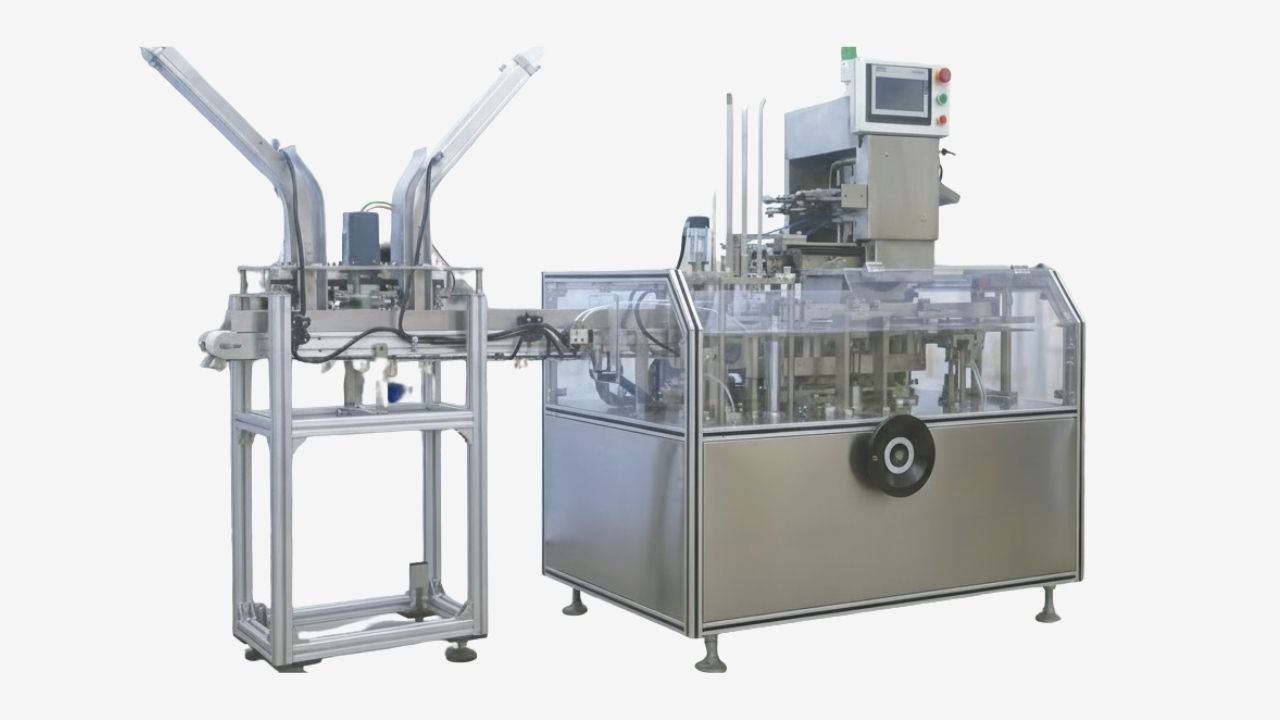
· Food Product Characteristics
If your product flows, it cannot be handled mechanically in discrete units. It resists being grouped, indexed, or pushed with precision. This means you will go for a vertical cartoner. However, if your product exists as discrete units and can be aligned, grouped, and pushed in a controlled way opens the door to horizontal cartoning. This is because with horizontal cartoners, precision and speed are their dominant advantage.
· Specify your Industry
The predictability of product geometry and the need for multipack retail formats should be your real drive in choosing. Therefore, if your production line requires pre-wrapping and a uniform size of your products, horizontal cartoners will work well for you. If your production line focuses mainly on free-flowing foods that are measured by weight or volume, vertical cartoners work perfectly.
· Production Volume
In the food packaging industry, product handling capability and speed play a critical role. However, this must not compromise the quality of the packaging in any way.
Under normal circumstances, horizontal packaging machines can handle about 60 to over 400 cartons per minute for intermittent cartoners. However, if you choose high-end speed, you can achieve over 600 cartons per minute for continuous cartoners.
On the other hand, vertical cartoners can achieve about 40 to 120 cartons per minute. However, for high-end speed cartoners with multi-head configurations, you can achieve up to 200 cartons per minute.
Product Loading Direction
Many food processing companies are moving towards cost-effective and hygienic packaging solutions.
For horizontal cartoners, your machine will push the product directly into the carton. Therefore, if you are making frozen pizzas, pasta boxed or snack bars, then you don’t have to worry about the barrel can or mechanical arms pushing items into the carton.
Furthermore, it is worth noting that loading products from the side allows for a “snug” fit, where the product fills the carton without rattling.
Another option you may consider for frozen peas, cereals or nuggets is the vertical loading. The top-loading mechanism makes this technique a perfect choice for loose or granular food products.
Floor Space
When your products are infeed and carton loading happens in a compact zone, then a vertical cartoner works much better. Remember, vertical cartoners require less floor space.
However, if your production needs high-speed flow and there is enough space then horizontal cartoners work much better. Remember, high-density automation reduces space but increases system complexity and dependency on uptime reliability.
Hygiene and Safety Compliance
A proper cartoner should use AISI 304 stainless steel, AISI 316 stainless steel, or food-grade polymers where necessary. Confirm if the cartoner also supports tool-less disassembly of product-contact parts and quick access to conveyor and forming zones.
Recently, most food processing factories are going for vertical cartoners for “dusty” food products such as spices or flour. With this loading mechanism, the entire process takes place in one spot. Therefore, you can install other accessories like dust extraction hoods.
FAQs
What is the difference between a horizontal cartoner and a vertical cartoner?
| Horizontal Cartoner | Vertical Cartoner |
| Products are usually fed from the side by mechanical pushing. | Products are fed from the top with the help of gravity |
| Has a high-speed capability | Speed capability mostly depends on product type. |
| Its integration point is at the primary packaging | Its integration point is often part of the filling process |
| Best for Rigid, uniform, pre-packed product type | Best for loose, fragile, irregular |
Can you integrate cartoners with other packaging equipment?
Yes. You can integrate cartoners with other packaging equipment if you have a stable upstream process and centralized control systems.
What are the advantages of horizontal cartoners?
- They work on continuous motion operation, allowing extremely high output rates.
- Have precise product positioningbefore insertion that results in a strong retail presentation.
- They’re designed for continuous, synchronized production environments,reducing manual handling.
What are the advantages of vertical cartoning machines?
- They have better suitability for low-to-medium speed production
- Built with a compact design, which makes them easier to integrate into tight plants.
- Vertical cartoners are mechanically simpler, less synchronized, motion-heavy, and easier to maintain and troubleshoot.
Can one cartoning machine handle both horizontal and vertical loading?
Yes. One cartoning machine can be designed to handle both horizontal and vertical loading if built with modular loading systems.
Is gravity-loading safe for fragile foods?
Yes. Gravity loading is safe for fragile foods only under tight control conditions.
What is the average changeover time between different box sizes?
The average changeover time between boxes is between 10 minutes and 90 minutes, depending on the level of automation. Of course, this applies to both horizontal and vertical cartoners.
Partner with Neocarton
For over 10 years, Neocarton has supported many factories in the food and processing industries with cGMP-compliant cartoning machines. Our horizontal and vertical cartoners are engineered for accurate carton forming, filling, and sealing.
Whether you are looking for custom-made or Neocarton standard machines, our engineers support your factory in every step – get a quote now.